Food-safety technique
How to Use a Food Thermometer for Slow-Cooker Meals
Check the thickest part, avoid bone and fat, and verify more than one piece when a batch contains different sizes.
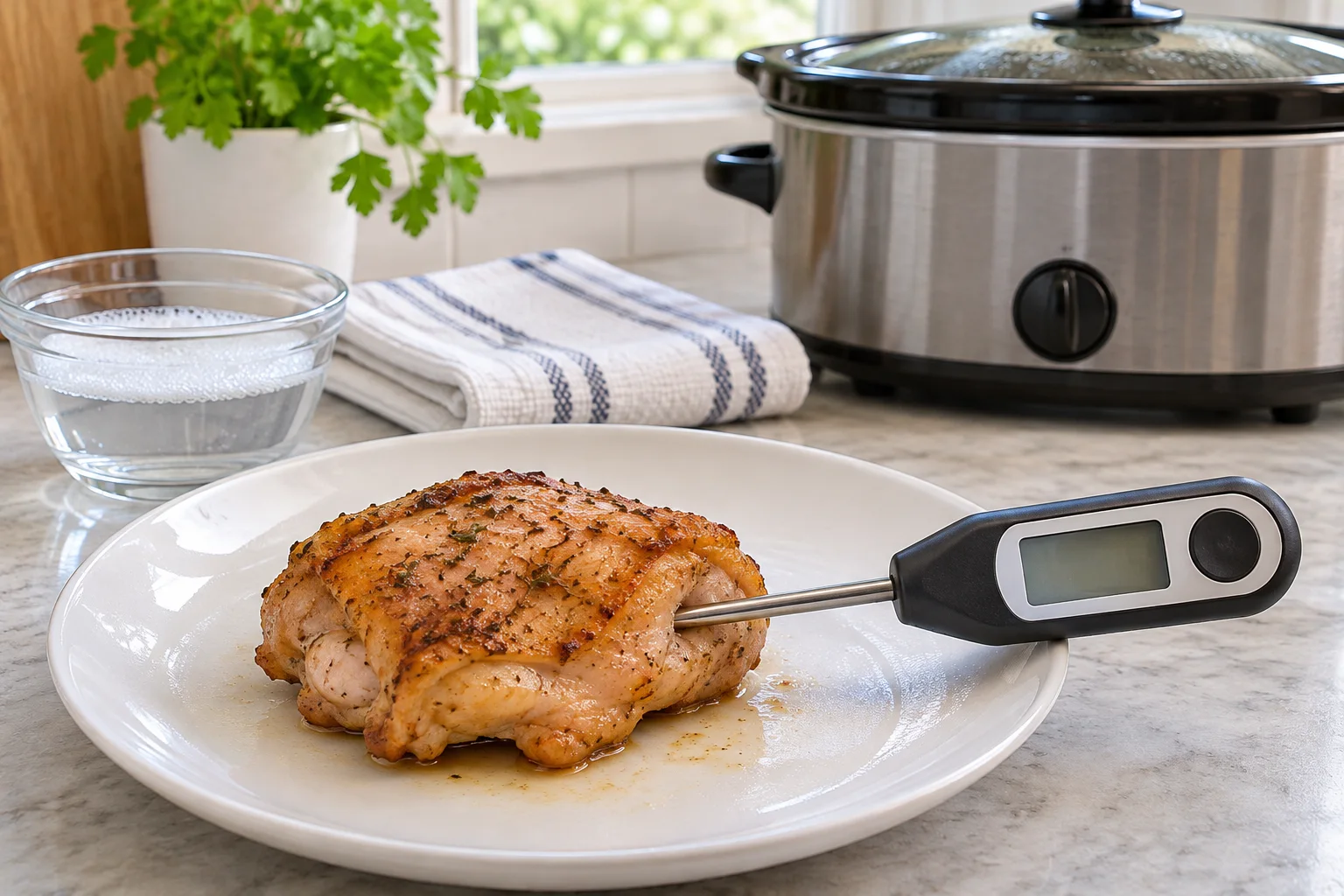
Hours in a slow cooker do not prove that meat is safe. USDA guidance says a thermometer is the only reliable way to verify the center has reached a safe minimum temperature. Color, clear juices, tenderness, and a recipe’s clock are useful clues—not safety tests.
A reliable checking routine
- Use the right tool. An instant-read thermometer is designed for spot checks. Do not leave it in the cooker. Leave-in probes should remain in food only if their manufacturer specifically permits that use.
- Start near the early end of the recipe’s range. Lift the lid only when you are ready to check so you do not repeatedly release heat.
- Choose the thickest part. Insert the probe into the center of the thickest section, away from bone, fat, gristle, and the hot crock. For a thin piece, insert the probe sideways so the sensing area reaches the center.
- Wait for a stable reading. Follow the model’s instructions; response times vary.
- Check more than one place. Test several pieces when their sizes differ. A large roast should be checked in two or three thick areas. Use the lowest accurate reading to decide whether cooking is complete.
- Clean between checks. Wash the probe with hot, soapy water before and after it touches food. Do not let a probe that touched undercooked meat contaminate cooked food, utensils, or a clean plate.
Where to check common slow-cooker foods
- Boneless chicken thighs or breasts: through the side into the thickest center; check the largest pieces.
- Bone-in chicken: in the thickest meat without touching the bone.
- Roasts: into the central thickest area, avoiding seams of fat and bone; repeat in another area.
- Meatballs or ground-meat loaves: in the center of the largest pieces.
- Soups, chili, and casseroles: stir if the recipe allows, then check in several places without touching the crock.
Safe minimum temperatures
| Food | Minimum internal temperature |
|---|---|
| Chicken, turkey, and other poultry | 165°F (74°C) |
| Ground beef, pork, veal, or lamb | 160°F (71°C) |
| Whole cuts of beef, pork, veal, or lamb | 145°F (63°C), then rest 3 minutes |
| Casseroles and leftovers | 165°F (74°C) |
| Fish with fins | 145°F (63°C) |
These are safety minimums, not always the texture target. A chuck roast or pork shoulder may be safe at a lower temperature than the point at which its connective tissue has softened enough to shred.
What to do when one piece is not ready
Keep cooking the batch and recheck after a short interval. If smaller pieces have already reached a safe temperature and the recipe permits, move them with clean utensils to a clean, covered dish while thicker pieces finish. Do not return cooked food to a plate that held it raw.
Common mistakes
- Touching the ceramic insert and reading the crock’s heat instead of the food’s center
- Checking only the smallest piece
- Stopping at the first rapidly changing number
- Relying on a pop-up timer, color, or cooking time alone
- Using the cooker’s Warm setting to cook raw food
- Reheating refrigerated leftovers in a slow cooker instead of reheating rapidly to 165°F first
Put the method into practice
Use the routine with maple-mustard chicken thighs and sweet potatoes, herb-garlic turkey tenderloin, or cranberry-balsamic pork loin. If meat is still frozen, follow the safe thawing guide rather than extending the slow-cooker time.
Sources and review date
Checked November 9, 2026: USDA thermometer placement guidance, FoodSafety.gov minimum temperatures, FoodSafety.gov slow-cooker safety, and FoodSafety.gov four safety steps.