Essential knife skill
How to properly dice an onion
A stable board, a sharp knife, and the onion's natural layers make neat, even pieces easier—and safer—than rushing through the cuts.
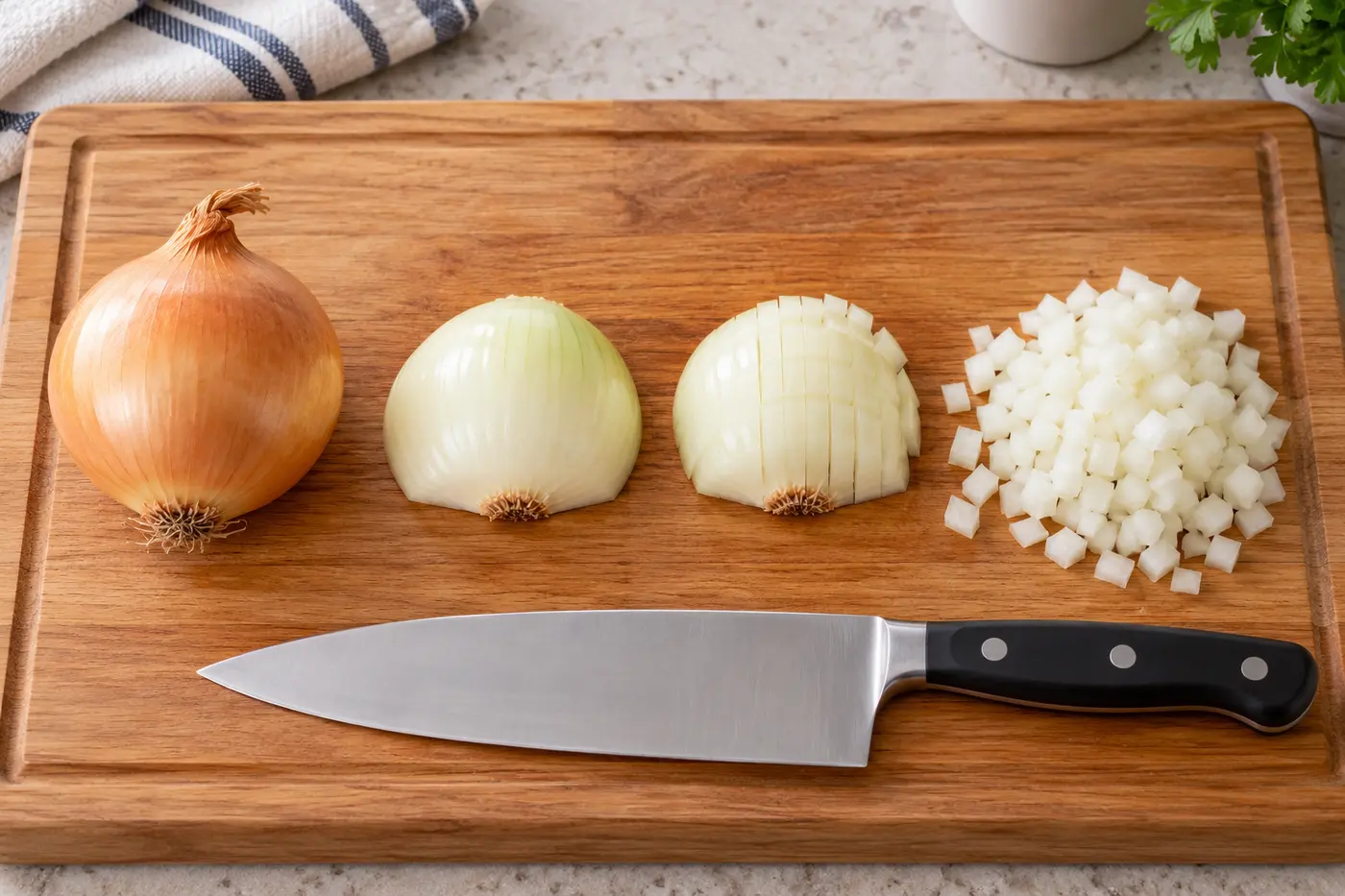
Evenly diced onion cooks at an even rate. Large pieces will stay firm while tiny pieces may scorch, so the goal is consistency—not restaurant speed.
Set up a safe work area
Use a large cutting board on a dry counter. If the board slides, place a damp paper towel or thin damp kitchen towel underneath it. Choose a sharp chef's knife that feels comfortable in your hand. A dull blade requires more force and is more likely to slip.
Step-by-step method
- Trim the stem end. Cut off the pointed stem end, but leave the hairy root end attached. Remove only loose root fibers if necessary; do not cut deeply into the root plate.
- Cut the onion in half. Stand the onion on the freshly cut stem end. Slice straight down through the center of the root, creating two halves.
- Peel it. Place each half flat-side down. Remove the papery skin and the first outer layer if it is dry, damaged, or leathery.
- Make lengthwise cuts. With the flat side firmly on the board, make parallel cuts from the stem side toward the root. Stop about ½ inch before the root so the onion remains connected. Space cuts according to the dice size you want.
- Cut across the onion. Rotate or reposition the half so the stem side faces the knife. Slice crosswise using the same spacing. The onion's curved layers separate the strips into dice as you cut.
- Finish near the root. When there is too little onion left to hold safely, turn the remaining piece flat and make the last few controlled cuts. Discard the firm root plate.
Do you need horizontal cuts?
For most home cooking, no. The onion's natural layers already create horizontal divisions, so lengthwise cuts followed by crosswise cuts produce a useful, even dice. Some classical techniques add one or two horizontal cuts, but they place the knife parallel to the cutting board and can be less comfortable for beginners. Skip them unless you are confident and specifically need a very fine dice.
Choose the right dice size
Reduce onion tears
A sharp knife crushes fewer cells and can release less irritating vapor than a dull one. Chilling the onion for 15–20 minutes may also help, and working near a vent or small fan can move vapor away from your eyes. Avoid soaking the onion before cutting; a wet onion is harder to grip and may lose flavor.
Storage and cleanup
Place unused diced onion in a tightly covered food-safe container and refrigerate promptly. For best quality, use it within 3–4 days. Discard onion that becomes slimy, moldy, unusually soft, or develops an unpleasant odor. Wash the knife, board, and work surface with hot soapy water after preparation.
Using diced onion in slow-cooker recipes
Medium dice works well in most slow-cooker soups, roasts, gravies, and shredded-meat recipes. Put onions near the bottom of the cooker when you want them very soft and fully blended into the cooking liquid. Use larger pieces when you want more texture after several hours of cooking.
Next kitchen skill
Continue with our step-by-step guide to properly dicing tomatoes, including methods for round and Roma varieties.