Potlucks and church meals
How to Transport Slow-Cooker Food Safely
Keep the cooker upright, the lid secure, and hot food at a verified 140°F or above from kitchen to serving table.
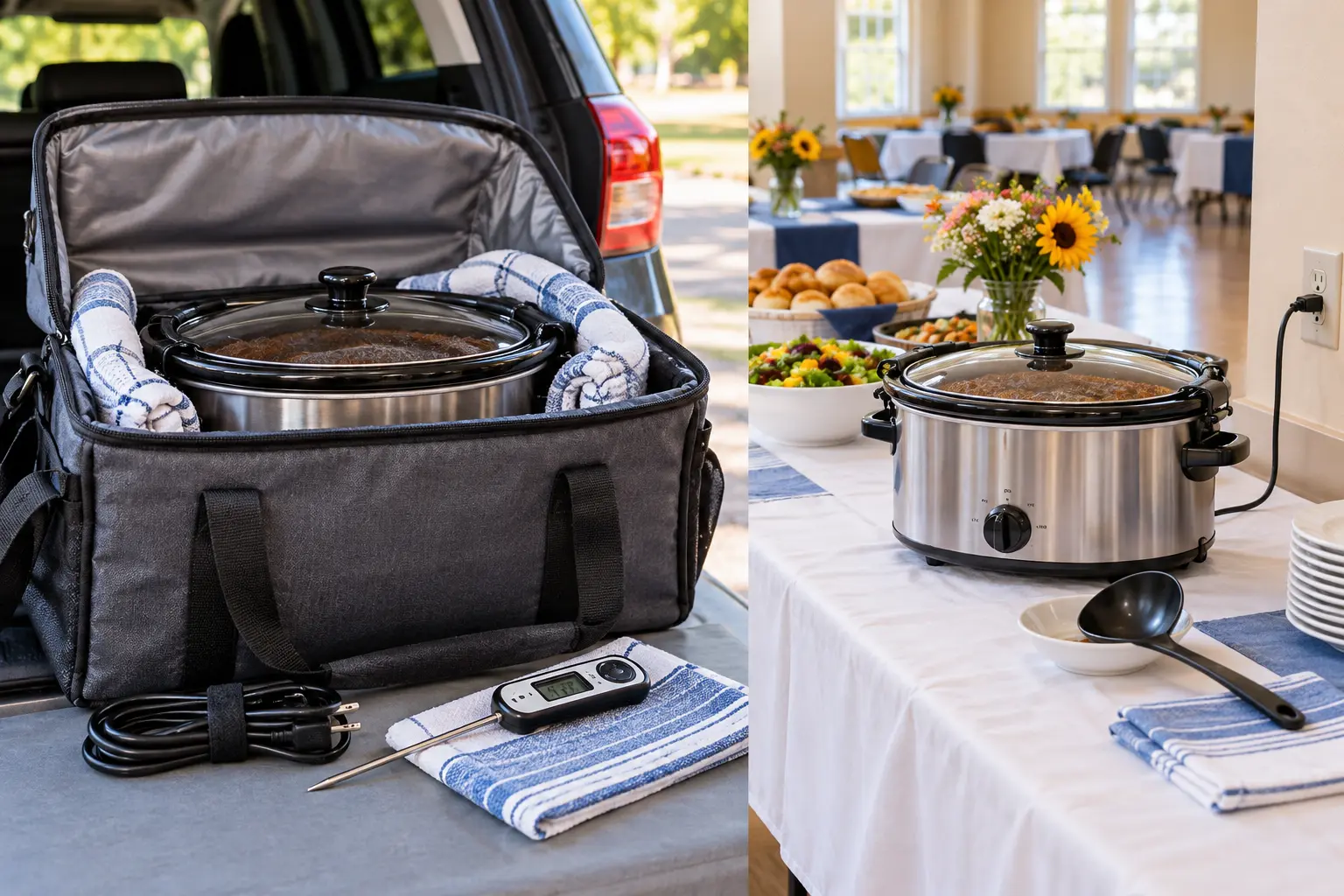
A slow cooker is useful for church meals, family gatherings, and potlucks, but the trip interrupts active heating. Plan the route, serving location, and electrical outlet before the food finishes so you can limit time in the 40–140°F temperature danger zone.
Before leaving home
- Cook the food completely. Verify the recipe’s safe internal temperature with a food thermometer. Do not transport partially cooked meat to finish later.
- Preheat an insulated carrier if its instructions allow. Empty any warming water and dry the carrier before loading. Never add an unapproved heat source.
- Unplug and close the lid. Use the manufacturer’s transport lock only as directed. A lock designed for travel may need to be released before heating.
- Keep the cooker upright. Place it on a flat vehicle surface inside a fitted carrier or sturdy box. Use folded towels around—not beneath unstable feet—to limit sliding. Keep the cord secured and the cooker away from passengers.
- Bring the thermometer and serving utensil separately. Do not open the lid during the drive merely to check the food.
Never operate an ordinary household slow cooker in a moving vehicle unless its manufacturer specifically approves that use and the vehicle setup is designed for it.
Track time and temperature
Hot food should be held at 140°F or above. Check the center soon after arrival. If it remains at least 140°F, plug in the cooker and use the manufacturer’s hot-holding setting. If it has fallen below 140°F, the safest decision depends on elapsed time: perishable food should not remain in the 40–140°F range for more than two hours total, or one hour when exposed to temperatures above 90°F, such as a hot car.
Do not taste food to decide whether it is safe. When the time or temperature history is uncertain, discard it.
At the serving table
- Set the cooker on a stable, heat-resistant surface where the cord cannot create a trip or spill hazard.
- Release any transport lock before heating if the manual requires it.
- Keep the lid closed between servings and verify the food stays at least 140°F.
- Use a clean serving utensil and replace it if it falls or becomes contaminated.
- Keep children away from the hot exterior, steam, cord, and lid.
If the food starts cold
A slow cooker should not reheat refrigerated leftovers. Reheat chilled cooked food rapidly on the stove, in the microwave, or in the oven until it reaches 165°F. Then transfer it hot to a preheated slow cooker for holding at 140°F or above.
After the gathering
Count time away from verified hot holding. Refrigerate perishable food within two hours, or one hour above 90°F. Divide large amounts into shallow containers rather than cooling food in the deep crock. Follow the complete leftovers guide for cooling and reheating.
A compact packing checklist
- Lidded cooker and manufacturer-approved lock or clips
- Fitted insulated carrier or sturdy upright box
- Clean folded towels for side support
- Food thermometer
- Clean serving utensil and spoon rest
- Oven mitts and a clean towel for condensation
- Shallow containers for leftovers
Try the routine with cranberry-balsamic pork loin. For advance preparation, review how to prep a slow-cooker meal the night before.
Sources and review date
Checked November 2, 2026: USDA hot-holding guidance, USDA buffet guidance, and FoodSafety.gov food-safety steps.